What Is a Transit of Venus? Explained With Real Numbers
Venus crosses the Sun as a dot 1/32 of its width for about six hours. The four contacts, how it differs from an eclipse, and why it is so rare.
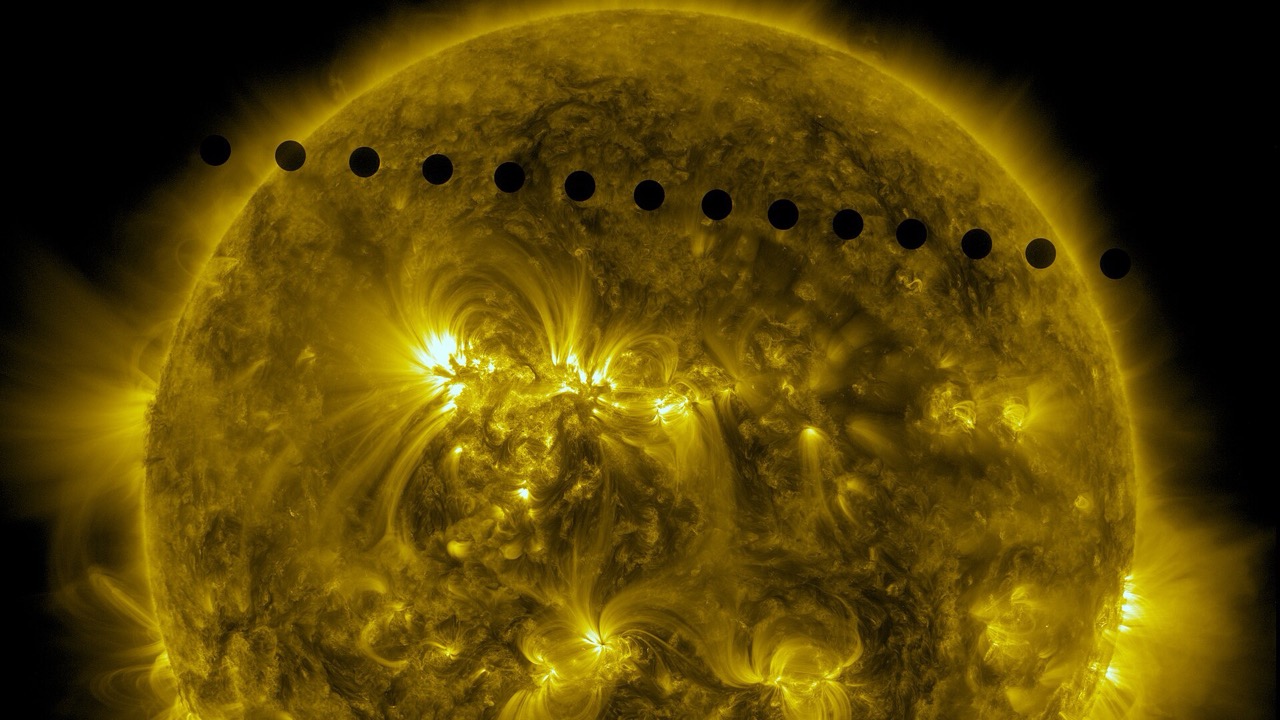 Image by NASA/Goddard Space Flight Center/SDO · Publiek domein, free of copyright · via Wikimedia Commons.

A transit of Venus is when Venus passes exactly between Earth and the Sun and shows up, through a solar filter, as a small black dot crossing the Sun’s face for several hours. The last one was on June 5–6, 2012; the next is on December 10–11, 2117.
What you actually see
A round black dot, about 1/32 as wide as the Sun, moving slowly from one edge of the disk to the other over five to seven hours.
The dot is small but definite. In a June transit, NASA notes, Venus is a disk of about 58 arcseconds, 1/32.6 of the Sun’s width. An arcsecond is 1/3,600 of a degree; the full Moon is about 1,900 of them wide, and so is the Sun. December transits show both a little bigger, because Earth is then close to its nearest point to the Sun. In 2117, according to the transit canon of the IMCCE in Paris, Venus will be 63.1 arcseconds across and the Sun 1,948.6, a ratio of about 1 to 31.
| June transit (2012 type) | December transit (2117 type) | |
|---|---|---|
| Venus, width | about 58″ | 63.1″ |
| Sun, width | about 1,890″ | 1,948.6″ |
| Venus as a share of the Sun’s width | 1/32.6 | 1/30.9 |
| Share of the Sun’s area covered | about 0.094% | about 0.105% |
| Drop in the Sun’s brightness | about 0.001 magnitude | about 0.001 magnitude |
The last two rows are our own arithmetic from those widths. A dot covering a tenth of a percent of the Sun changes nothing you could notice without instruments. The sky doesn’t darken and the Sun looks as bright as ever.
NASA describes Venus during a transit as “just possible to see without optical magnification (but using solar filter protection).” It sits close to the limit of what the eye can resolve. Binoculars or a small telescope, with a solar filter mounted in front, show it as a clear black disk.
How fast does it move?
Slowly. In 2117 the center of Venus will travel about 1,397 arcseconds from first to last contact in 5 hours 39 minutes 33 seconds: roughly 4 arcseconds a minute. At that speed Venus moves its own width in about 15 minutes. Look away for a quarter of an hour and you’ll see it has shifted; watch it for one minute and it seems to stand still.
How long does it last?
It depends on where Venus crosses. A path through the middle of the Sun is a long chord; a path near the edge is a short one.
| Transit | Closest to the Sun’s center | Length |
|---|---|---|
| December 4, 1639 | 524″ | 6h 57m 39s |
| June 3–4, 1769 | 609″ | 6h 19m 50s |
| December 9, 1874 | 830″ | 4h 36m 43s |
| June 5–6, 2012 | 554″ | 6h 39m 57s |
| December 10–11, 2117 | 724″ | 5h 39m 33s |
“Closest to the Sun’s center” is how far the center of Venus passes from the center of the Sun at mid-transit. The Sun’s radius is about 945″ in June and 974″ in December, so 1874, at 830″, ran well off the middle and was the shortest transit anyone has observed.
The four contacts
Astronomers time a transit by four moments, called contacts, when the edge of Venus touches the edge of the Sun.
| Contact | What touches | What you see | 2012 (UT) | 2117 (UT) |
|---|---|---|---|---|
| I | Venus touches the Sun’s edge from outside | A tiny dent appears in the Sun’s rim | 22:09:38, June 5 | 23:58:35, December 10 |
| II | Venus touches the edge from inside | The whole black disk is on the Sun | 22:27:34 | 00:21:31, December 11 |
| Greatest transit | (no contact) | Venus is closest to the Sun’s center | 01:29:36, June 6 | 02:48:21 |
| III | Venus reaches the far edge, touching from inside | The disk starts to leave | 04:31:39 | 05:15:12 |
| IV | Venus touches the edge from outside | The last dent closes; the transit is over | 04:49:35 | 05:38:08 |
The 2012 times come from NASA’s predictions, the 2117 times from the IMCCE canon. UT is Universal Time, essentially Greenwich time; subtract five hours for Eastern Standard Time.
The stretch from I to II is called ingress, and it takes roughly 18 to 23 minutes: 17 minutes 56 seconds in 2012, 22 minutes 56 seconds in 2117. On a path close to the Sun’s edge Venus meets the rim at a slant and ingress drags on. In 1874 it took 29 minutes 27 seconds. Egress, from III to IV, mirrors it.
Contacts II and III are the hard ones to time. Just before second contact, Venus seems stuck to the Sun’s edge by a short dark thread, the black drop effect, and the true contact is the instant the thread breaks. That blur around the moment of contact plagued observers in 1761, 1769, 1874 and 1882.
The times in the table are geocentric, meaning as seen from the center of the Earth. From any real place on the surface, each contact comes up to about 7 minutes earlier or later. That small difference turned out to be the most useful thing about transits, as the section on why astronomers cared explains.
Why you need a solar filter
Because Venus blocks only about a tenth of a percent of the sunlight. Looking at the Sun during a transit is exactly as dangerous as on any other day.
NASA’s safety rules apply in full:
- Use only solar viewers that meet the ISO 12312-2 standard. Ordinary sunglasses are not safe, however dark.
- Binoculars, cameras and telescopes need a proper solar filter mounted in front of the lens. Never use eclipse glasses behind binoculars or a telescope eyepiece instead.
- A pinhole projection, which throws an image of the Sun onto paper, is safe.
During a total solar eclipse there are a few minutes when the Moon hides the Sun completely and you can look without protection. A transit has no such moment.
Transit, eclipse, conjunction, opposition: what’s the difference?
A transit and a solar eclipse are the same kind of lineup with a different body in front. A conjunction is the lineup in general, and an opposition is the opposite arrangement, which Venus can never reach.
| Event | What happens | How big against the Sun | How often |
|---|---|---|---|
| Transit of Venus | Venus passes exactly across the Sun’s face | 1/32 of the Sun’s width, about 0.1% of its area | In pairs eight years apart, then gaps of 105.5 or 121.5 years; next December 10–11, 2117 |
| Transit of Mercury | Mercury passes across the Sun’s face | About 10″, 1/194 of the Sun’s width | About 13 times a century; next November 13, 2032 |
| Solar eclipse | The Moon passes in front of the Sun | The Moon is about 1,896″ wide, the Sun 1,887″ to 1,952″, so it can cover all of it | Two in 2027, one of them total (August 2, over Spain and North Africa); the next total one in the Lower 48 is August 23, 2044 |
| Inferior conjunction of Venus | Venus passes between Earth and the Sun, usually above or below it | Nothing covered | Every 584 days |
| Opposition | A planet sits on the far side of Earth from the Sun | Not applicable | Only planets farther out than Earth, such as Mars and Jupiter; never Venus or Mercury |
Every transit of Venus happens at an inferior conjunction, but almost no inferior conjunction is a transit. Venus passes Earth on the inside track every 583.92 days, and nearly every time it slips by a few degrees above or below the Sun, sometimes as much as 9 degrees, more than fifteen times the Sun’s width.
Mercury transits are the closest thing you can watch in a lifetime. Mercury is about a sixth the width Venus shows, so you need a telescope with a solar filter: Fred Espenak recommends a magnification of 50 or more. The 2032 transit is poorly placed for the United States, ending before sunrise in the Lower 48.
Why transits of Venus are so rare
Because Venus’s orbit is tilted 3.4 degrees to Earth’s, it can only cross the Sun when it passes us in early June or early December. Those dates line up in pairs eight years apart, followed by a gap of more than a century.
Eight Earth years are almost exactly five passes of Venus, which is why a second transit follows the first. The match is about 2.45 days off, though, so the third pass misses the Sun. NASA’s catalog sums up the pattern as 8 years, then 105.5, then 8, then 121.5, repeating every 243 years. Since the telescope was invented there have been eight transits: 1631, 1639, 1761, 1769, 1874, 1882, 2004 and 2012. The arithmetic behind the pattern, and every date from 1631 to 2255, is in When is the next transit of Venus?
Why astronomers cared so much
Because timing a transit from places far apart on Earth gives the distance to the Sun, the yardstick for the whole solar system.
Observers in different places see Venus cross along slightly different lines, so the transit lasts a few minutes longer for some than for others. Edmond Halley showed in 1716 how to turn those minutes into the solar parallax, and from it the distance to the Sun. That is why Captain Cook sailed to Tahiti for the transit of June 1769 and why governments sent expeditions around the world in 1874 and 1882. How the method works, with a worked example, is in how transits of Venus measured the distance to the Sun; the people and the voyages are in our history of every transit of Venus.
Frequently asked questions
What is a transit of Venus?
It is the moment Venus passes exactly between Earth and the Sun. Seen through a solar filter, Venus shows up as a small round black dot that takes several hours to cross the Sun's face.
Can you see a transit of Venus with the naked eye?
Just barely, and only through a certified solar filter. Venus is about 1/32 of the Sun's width, close to the limit of what the eye can pick out. Binoculars or a small telescope with a solar filter in front of the optics show it far better.
How long does a transit of Venus last?
Usually five to seven hours. The 1874 transit lasted 4 hours 37 minutes, the 1639 transit almost 7 hours, and the next one, in December 2117, will last 5 hours 39 minutes 33 seconds.
What is the difference between a transit and a solar eclipse?
Both are lineups of the Sun with something passing in front of it. In an eclipse the Moon is the blocker, and it looks as big as the Sun, so it can cover all of it. In a transit of Venus the planet covers only about 0.1 percent of the Sun.
When is the next transit of Venus?
December 10–11, 2117. In US time it begins on December 10 at 6:58 p.m. EST (3:58 p.m. PST). The one after that is December 8, 2125.
Keep reading
More from the sky calendar
- Transits · 10 min readWhen Is the Next Transit of Venus? Not Until 2117The next transit of Venus is December 10–11, 2117, then December 8, 2125. US times, every transit from 1631 to 2255, and why they come in pairs.
- Transits · 9 min readTransit of Venus 2117: Date, Times and Where to See ItDecember 10–11, 2117: all four contact times in UT and US time zones, where on Earth it is visible, and why it repeats the transit of 1874.
- History · 6 min readJeremiah Horrocks and the 1639 Transit of VenusHorrocks predicted the 1639 transit of Venus and saw it through a gap in the clouds. Only he and William Crabtree watched. The dates, the times, the miss.