How the Transit of Venus Measured the Distance to the Sun
Halley's method in plain steps with a worked example, and every attempt from Horrocks to the 2012 IAU definition, with how far each one was off.
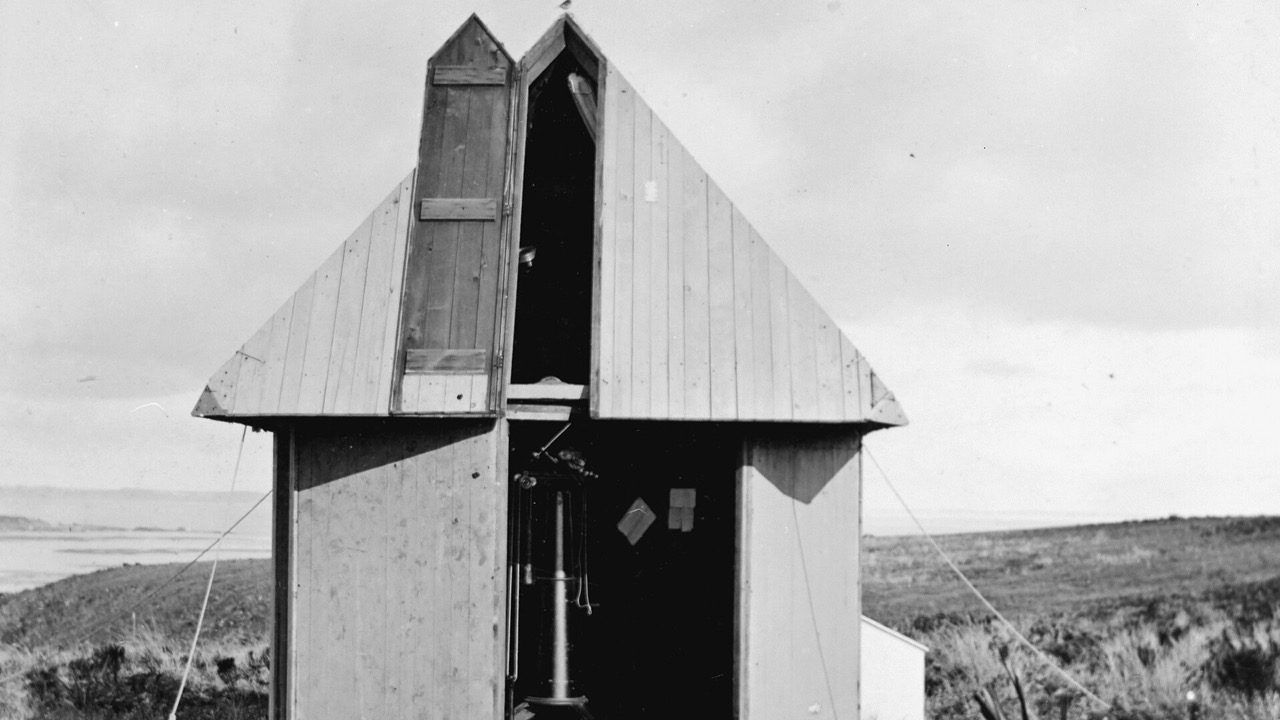 Image by William H. Rau · Publiek domein, free of copyright · via Wikimedia Commons.

Observers far apart on Earth see Venus cross the Sun on slightly different tracks, so the transit lasts minutes longer in one place than another. Edmond Halley showed how that gives the distance to the Sun; the 1769 data came within 0.16 percent of it.
The problem: a perfect map without a scale
By the 17th century astronomers knew the shape of the solar system but not its size. Kepler’s third law links a planet’s orbital period to its distance from the Sun, so the periods gave every distance as a fraction of Earth’s. Venus goes around in 224.701 days against Earth’s 365.256, which puts it at 0.723 times Earth’s distance. But 0.723 of what? Nobody knew how many miles one Earth-Sun distance was.
One measured distance would scale the whole map. The trouble is that the Sun is too far to triangulate directly: seen from the Sun, Earth’s radius spans only about 8.8 arcseconds, the solar parallax. An arcsecond is 1/3,600 of a degree.
Jeremiah Horrocks, who saw the transit of 1639, put the distance at no less than 15,000 Earth radii, about 60 million miles. That was about a third too small, and a guess as much as a measurement.
Halley’s idea, step by step
Edmond Halley began thinking about transits as a measuring tool in 1677, on St Helena. He read his method to the Royal Society in 1691 and published it in the Philosophical Transactions in 1716. Here it is in four steps, with numbers you can check yourself.
1. Venus is much closer to us than the Sun. At a transit Venus is about 0.28 of the Earth-Sun distance away (1 minus 0.723), the Sun a full 1.
2. Move sideways and Venus shifts against the Sun. If two observers stand a distance B apart, across the line of sight, each sees Venus in a slightly different place on the Sun’s disk. Because Venus is closer, it shifts more than the Sun does. The size of the shift is B divided by the Earth-Sun distance, times a factor of (1 ÷ 0.277) − 1 = 2.61. For two observers one Earth radius apart, the shift is 2.61 times the solar parallax: with today’s value of 8.794 arcseconds, about 23 arcseconds, some two-fifths of Venus’s own width.
3. A shifted track means a different duration. Venus crosses the Sun as a straight chord. A track farther from the center is a shorter chord and takes less time. Take the real geometry of June 1769 from the IMCCE canon: Venus crossed 609 arcseconds from the Sun’s center, moving about 4 arcseconds a minute. Put one observer’s track 11.5 arcseconds farther from the center and another’s 11.5 closer, 23 apart in total, and the time Venus spends fully on the disk differs by about 10 minutes between them.
4. Run it backward. Measure the two durations, turn them into chord lengths and the chords into track positions, and you have the shift in arcseconds. Then:
Earth-Sun distance = 2.61 × B × 206,265 ÷ shift in arcseconds
The 206,265 converts arcseconds into a plain ratio. With B = 6,378 km, one Earth radius:
| Shift you measure | Distance to the Sun | In miles | Compared with today’s value |
|---|---|---|---|
| 22.0″ | 156.1 million km | 97.0 million | 4% too large |
| 23.0″ | 149.3 million km | 92.8 million | 0.2% too small |
| 24.0″ | 143.1 million km | 88.9 million | 4% too small |
Every arcsecond of error in the shift moves the answer by about 4 percent. That’s why Halley cared so much about timing. A difference of ten minutes between stations is 600 seconds; he claimed that if observers got the duration right to within 2 seconds, the parallax could be pinned down to one part in 500.
This is the bare geometry. Real reductions also had to allow for Earth’s rotation, which carries each observer along during the six hours of a transit, and for exactly where on the globe each station stood. Halley suggested places far apart north and south: Hudson Bay, Madras, Bencoolen on Sumatra, Pondicherry, Batavia, and the north of Norway or Scotland. The French astronomer Joseph-Nicolas Delisle later improved the method, so that a station needed to time only one contact, provided its position on Earth was well known.
1761 and 1769: the first campaigns
The first two campaigns narrowed the distance from a guess to within a few percent, but the answers scattered.
For 1761 the Smithsonian Libraries count more than 120 recorded observations. The resulting values of the solar parallax ran from 8.28 to 10.6 arcseconds, or roughly 77 to 99 million miles. Observers struggled with war at sea and with the black drop, a dark thread that seems to tie Venus to the Sun’s edge at the moments of inner contact and blurs the exact time.
For 1769 there were more than 150 observations, including James Cook’s at Tahiti and Jean-Baptiste Chappe d’Auteroche’s in Baja California. Cook, Charles Green and Daniel Solander stood side by side on a cloudless day, and still, in Cook’s words, “differ’d from one another in observeing the times of the Contacts much more than could be expected.” The full story of that expedition is in Captain Cook and the 1769 transit of Venus.
Then came the reductions, and they did not agree:
- Maximilian Hell (1770): 151.7 million km, about 94.3 million miles.
- Jérôme Lalande (1771): 153 million km, plus or minus 1 million, about 95.1 million miles.
- Thomas Hornsby, Oxford, from Tahiti and four other stations: a parallax of 8.78 arcseconds, about 93.1 million miles.
- Johann Encke, who reworked all the 1761 and 1769 data in the 1820s: 8.5776 arcseconds, a little over 95 million miles.
The Smithsonian sums up the combined results of 1761 and 1769 as 94 to 96 million miles. The irony is in the last two lines. Hornsby’s figure was the closest, yet the most complete reanalysis, Encke’s, gave a larger number that later proved too large. The values for Hell, Lalande and Encke come from later summaries rather than their original papers; we give them as reported.
1874 and 1882: photography, Harkness and Newcomb
The 19th-century transits were national projects, with photographic plates replacing the eye at the telescope. They produced the most careful transit result, and yet decided less than anyone hoped.
For each transit the US Naval Observatory sent out eight expeditions. Steven Dick’s history of the American expeditions gives the appropriations as $177,000 for 1874 and $78,000 for 1882, $255,000 in all. Physics Today, in a profile of Simon Newcomb, puts the special appropriations for the whole program at $375,000. The two figures probably count different things; we give both. Newcomb himself became secretary of the American Transit of Venus Commission in 1871.
In 1894 William Harkness of the Naval Observatory published the American result: a solar parallax of 8.809 arcseconds, plus or minus 0.0059, a distance of 92,797,000 miles, plus or minus 59,700. That is 0.17 percent short of today’s value, with a stated uncertainty of less than a tenth of a percent.
Newcomb, who built the system of astronomical constants that the world would use, weighed the evidence differently. He gave the photographic transit results a weight of 2, against 40 for measurements of the aberration of starlight at Pulkovo Observatory. As Dick concludes, the transits of Venus played little part in the official value of the 20th century. Newcomb’s constants were accepted in principle in Paris in 1896, became the international standard in 1901, and were adopted for the American Nautical Almanac only in 1912.
Newcomb did also combine the data of the last four transits on their own, arriving at about 149.59 million km, plus or minus 0.31 million. That lands within 0.01 percent of today’s value, but his own uncertainty was about 0.2 percent. The near-perfect match is partly luck.
2004: 1,510 observers and their timings
The first transit in 121.5 years became a public experiment. The European Southern Observatory’s VT-2004 program collected 4,550 contact timings from 1,510 registered observers before its July 10, 2004, deadline, and worked out an astronomical unit of 149,608,708 km, plus or minus 11,835 km.
That is 10,838 km, or 0.007 percent, from the radar value, and inside the stated uncertainty. With nothing but timings of a dot on the Sun, the method Halley described in 1716 landed closer than the government expeditions of 1874 and 1882.
Every attempt, side by side
Each result is set against today’s value of 149,597,870.7 km, or 92,955,807 miles. Where a result was given as a parallax, we converted it to distance using Earth’s equatorial radius of 6,378.137 km; the percentages are our own arithmetic.
| Result | Who | Based on | Value | In miles | Off by |
|---|---|---|---|---|---|
| 1639 | Jeremiah Horrocks | His own transit observation | at least 15,000 Earth radii | about 60 million | about 35% too small |
| after 1761 | all observers | 1761 | parallax 8.28″ to 10.6″ | about 77 to 99 million | 17% too small to 6% too large |
| 1770 | Maximilian Hell | 1761 and 1769 | 151.7 million km | about 94.3 million | 1.4% too large |
| 1771 | Jérôme Lalande | 1761 and 1769 | 153 ± 1 million km | about 95.1 million | 2.3% too large |
| after 1769 | Thomas Hornsby | 1769, five stations | parallax 8.78″ | about 93.1 million | 0.16% too large |
| 1820s | Johann Encke | 1761 and 1769 | parallax 8.5776″ | about 95.3 million | 2.5% too large |
| 1894 | William Harkness | 1874 and 1882 | parallax 8.809″ ± 0.0059″ | 92,797,000 ± 59,700 | 0.17% too small |
| 1880s | Simon Newcomb | four transits | 149.59 ± 0.31 million km | about 92.95 million | under 0.01% (stated uncertainty 0.2%) |
| 2004 | ESO’s VT-2004 | 2004 | 149,608,708 ± 11,835 km | about 92.96 million | 0.007% too large |
| 2012 | IAU | definition | 149,597,870.7 km | 92,955,807 | exact by definition |
The sweep from 35 percent to 0.007 percent took 365 years. The biggest leap came between two transits eight years apart: from the spread of 1761 to Hornsby’s figure from 1769.
2012: when the distance stopped being a measurement
In August 2012, two months after the last transit of the century, the International Astronomical Union met in Beijing and, in resolution B2, fixed the astronomical unit at exactly 149,597,870,700 meters, with the symbol “au.”
Since then the Earth-Sun distance in kilometers is no longer something to be measured; it is a unit, like the meter. The transit of December 2117 will be watched for many reasons, but improving that number won’t be one of them.
Why it mattered
Because one number turned Kepler’s proportions into real sizes. Once the astronomical unit was known, everything measured in it could be converted to miles at once.
Two examples with today’s values. The Sun spans about 1,919 arcseconds at Earth’s mean distance; at 149.6 million km that makes it about 1.39 million km, or roughly 865,000 miles, across. Venus’s orbit, at 0.723 of Earth’s distance, becomes about 108 million km, or 67 million miles, from the Sun. The same yardstick reaches past the solar system: Earth’s orbit is the baseline for measuring the distances of nearby stars, so their distances, too, were only as good as the astronomical unit.
That is the answer to “why was the transit of Venus important”: for more than a century, from Halley’s paper to the expeditions of 1882, it was the method astronomers pinned their hopes on for the one distance on which all the others depended. What the transits themselves look like is in What is a transit of Venus?, and the people who chased them, from Horrocks to the space telescopes of 2012, are in our history of every transit of Venus.
Frequently asked questions
How did the transit of Venus measure the distance to the Sun?
Observers far apart on Earth see Venus cross the Sun along slightly different tracks, so the transit lasts a few minutes longer in one place than another. From that difference and the distance between the observers you get the solar parallax, and from the parallax the distance to the Sun.
Why was the transit of Venus important?
Kepler's laws gave the proportions of the solar system but not its size in miles. One real distance, Earth to Sun, scaled everything else, and transits of Venus were the best way to measure it in the 18th and 19th centuries.
How accurate were the transit measurements?
Results from 1761 ranged from 17 percent too small to 6 percent too large. Thomas Hornsby's figure from the 1769 data was 0.16 percent too large, William Harkness's from 1874 and 1882 was 0.17 percent too small, and the 2004 amateur campaign came within 0.007 percent.
What is the distance to the Sun today?
The astronomical unit, the mean Earth-Sun distance, has been fixed since August 2012 at exactly 149,597,870,700 meters, about 92,955,807 miles. It is now a definition, not a measurement.
Keep reading
More from the sky calendar
- History · 6 min readJeremiah Horrocks and the 1639 Transit of VenusHorrocks predicted the 1639 transit of Venus and saw it through a gap in the clouds. Only he and William Crabtree watched. The dates, the times, the miss.
- History · 7 min readThe 1761 Transit of Venus: The First Worldwide CampaignIn 1761 astronomers spread across the globe to time Venus crossing the Sun. Mason and Dixon, Le Gentil, Lomonosov, and why the results varied so widely.
- History · 7 min read1874 and 1882 Transits of Venus: The American ExpeditionsEight US expeditions per transit, $177,000 and $78,000 from Congress, and plates that gave Harkness 8.809". Why it barely counted in the official value.