Transit of Venus 2117: Date, Times and Where to See It
December 10–11, 2117: all four contact times in UT and US time zones, where on Earth it is visible, and why it repeats the transit of 1874.
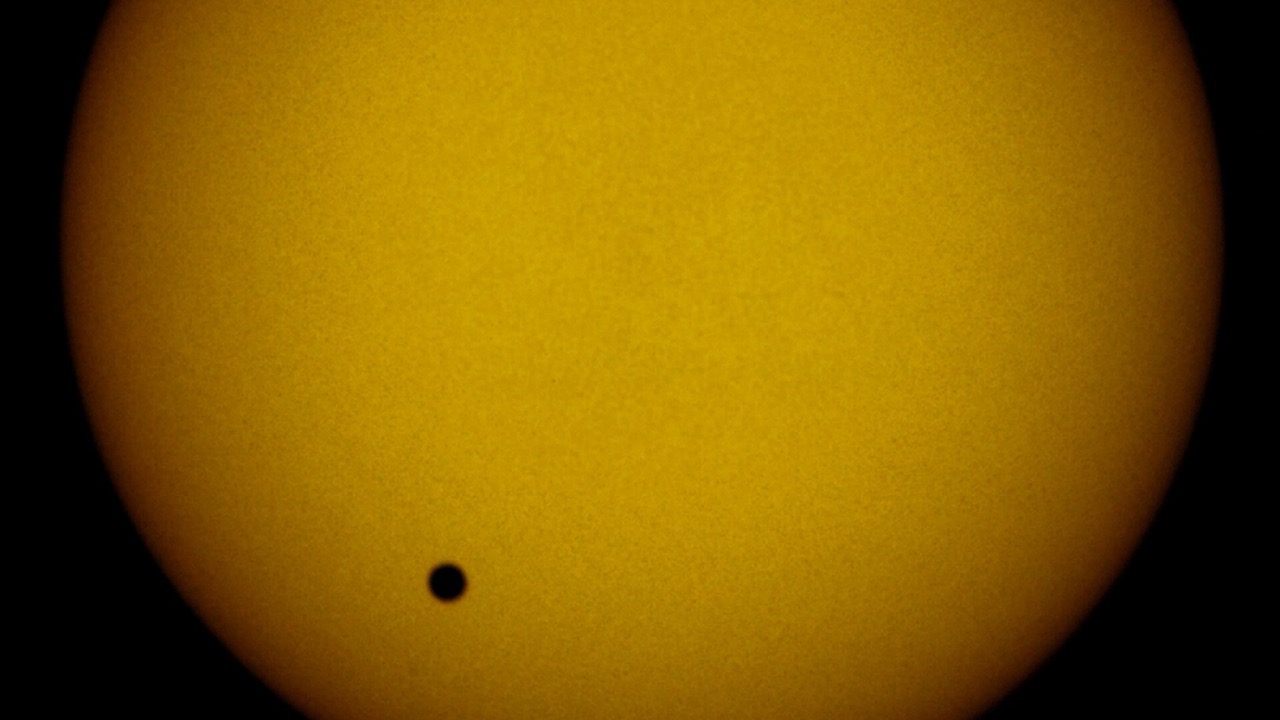 Image by GJDonatiello · CC BY-SA 4.0 · via Wikimedia Commons.

The 2117 transit of Venus begins at 23:58 UT on December 10, 2117 (6:58 p.m. EST) and ends at 05:38 UT on December 11, after 5 hours 39 minutes 33 seconds. East Asia, Australia and the western Pacific see all of it; in the United States, Guam sees all of it, while Hawaii, the Aleutians and the far West see only part.
The 2117 transit at a glance
- Date: December 10–11, 2117, in Universal Time, almost all of it on the 11th; December 10 in every US time zone, December 11 in Asia and Australia.
- First contact: 23:58:35 UT, December 10.
- Greatest transit: 02:48:21 UT, December 11, with Venus 723.6 arcseconds from the Sun’s center.
- Last contact: 05:38:08 UT, December 11.
- Length: 5 hours 39 minutes 33 seconds.
- Path: across the northern half of the Sun.
- Countdown: counted from November 18, 2026, first contact is 33,259 days away. That count already allows for 2100, which is not a leap year.
- Partner transit: December 8, 2125.
All times come from the canon of transits published by the IMCCE in Paris; NASA’s catalog agrees to the minute.
Contact times in UT and US time zones
| Moment | UT | Eastern | Central | Mountain | Pacific | Alaska | Hawaii |
|---|---|---|---|---|---|---|---|
| I: Venus touches the Sun’s edge | 23:58:35 (Dec 10) | 6:58 p.m. | 5:58 p.m. | 4:58 p.m. | 3:58 p.m. | 2:58 p.m. | 1:58 p.m. |
| II: Venus fully on the disk | 00:21:31 (Dec 11) | 7:21 p.m. | 6:21 p.m. | 5:21 p.m. | 4:21 p.m. | 3:21 p.m. | 2:21 p.m. |
| Greatest transit | 02:48:21 | 9:48 p.m. | 8:48 p.m. | 7:48 p.m. | 6:48 p.m. | 5:48 p.m. | 4:48 p.m. |
| III: Venus starts to leave | 05:15:12 | 12:15 a.m. (Dec 11) | 11:15 p.m. | 10:15 p.m. | 9:15 p.m. | 8:15 p.m. | 7:15 p.m. |
| IV: Venus is off the Sun | 05:38:08 | 12:38 a.m. (Dec 11) | 11:38 p.m. | 10:38 p.m. | 9:38 p.m. | 8:38 p.m. | 7:38 p.m. |
US times are on December 10 unless marked, using today’s standard-time offsets; nobody can say what the clock rules will be in 2117. The times are geocentric, as seen from Earth’s center. From your own location each contact shifts by up to about 7 minutes.
Where Venus touches the Sun is given as a position angle, measured from the Sun’s north point toward the east. In 2117 Venus enters at 58 degrees, on the northeast edge, and is fully on the disk at 54 degrees. It reaches the far edge at 334 degrees and leaves at 330 degrees, on the northwest side.
Where on Earth the 2117 transit is visible
The whole transit is visible from East and Southeast Asia, Australia, New Zealand and the western Pacific. South Asia, the Persian Gulf and East Africa see the later part, from sunrise onward. Western and central Europe and most of the Americas see nothing.
We worked this out from the Sun’s height above the horizon at each contact time, without allowing for refraction or the few minutes’ shift at each location, so treat the edges as approximate.
| Region | Sun at first contact | Sun at last contact | What you see |
|---|---|---|---|
| Japan (Tokyo) | about 21° | about 17° | All of it, from about 9:00 a.m. to 2:38 p.m. local time on December 11 |
| Korea (Seoul) | about 12° | about 22° | All of it |
| Eastern China (Beijing) | about 4° | about 24° | All of it, starting soon after sunrise |
| Philippines (Manila) | about 22° | about 44° | All of it |
| Southeast Asia (Jakarta, Bangkok) | about 19° and 5° | about 69° and 53° | All of it |
| Australia (Sydney, Perth) | about 64° and 34° | about 39° and 68° | All of it, across the whole country |
| New Zealand (Auckland) | about 76° | about 20° | All of it |
| India (Delhi) | below the horizon | about 36° | From sunrise, around 01:38 UT, before greatest transit |
| Persian Gulf (Dubai) | below the horizon | about 29° | From about 03:00 UT, the second half |
| East Africa (Nairobi) | below the horizon | about 31° | From about 03:24 UT, the last two hours |
| Western and central Europe (London) | below the horizon | below the horizon | Nothing |
| Southeastern and eastern Europe (Athens, Moscow) | below the horizon | on the horizon in Athens, about 2° below in Moscow | At most the final minutes at sunrise; in Moscow the Sun rises around the moment Venus leaves, so little or nothing |
timeanddate’s page for the 2117 transit lists the same picture: Tokyo, Seoul, Beijing, Manila, Jakarta, Sydney, Melbourne and Brisbane among the cities that see the transit, along with Delhi, Mumbai and Nairobi, which by our calculation see only part of it; Athens and Moscow it lists as seeing only a partial phase. Its times run about two minutes later than the IMCCE and NASA figures, because it uses a different calculation.
Seen from the United States
Only from the Pacific and the far West. By the time Venus touches the Sun, the Sun has set from the Rockies to the Atlantic.
| Place | Sun at first contact | What you see |
|---|---|---|
| Guam and Northern Mariana Islands | about 41° (28° at the end) | All of it, 9:58 a.m. to 3:38 p.m. local time on December 11 |
| American Samoa | high | Nearly all; the Sun reaches the horizon as Venus leaves |
| Hawaii (Honolulu) | about 40° | About two-thirds, from 1:58 p.m. HST until sunset around 5:47 p.m. |
| Aleutian Islands (Unalaska, Adak) | about 12° and 15° | Adak keeps Venus in view until a little after mid-transit |
| California (Los Angeles, San Francisco) | about 7° | Venus entering, low in the southwest, then sunset within the hour |
| Arizona (Phoenix) | about 3° | The entry at best; the Sun sets around second contact |
| Pacific Northwest, mainland Alaska | 1° to 3° | Possible on paper, unlikely in practice |
| The rest of the Mountain, Central and Eastern zones | below the horizon | Nothing |
More on US visibility, and how 2117 compares with every other transit as seen from America, is in When is the next transit of Venus?
How big Venus will look on the Sun
Venus will be 63.1 arcseconds across, the Sun 1,948.6, a ratio of about 1 to 31. That is a little bigger than in the June transits of 2004 and 2012, when the ratio was 1 to 32.6, because in December Earth is near its closest point to the Sun and both look larger. The planet will cover about 0.1 percent of the Sun’s area, far too little to dim the daylight.
Through a certified solar filter Venus will be just visible to the naked eye, as NASA said of 2012; binoculars or a small telescope with a filter in front show it clearly. It will need 22 minutes 56 seconds to move fully onto the disk and will then creep across at about 4 arcseconds a minute, covering its own width every quarter of an hour. What contacts I to IV mean, and why II and III are hard to time, is explained in What is a transit of Venus?
2117 repeats the transit of 1874, and 1631 before it
Transits repeat every 243 years, so each one has a predecessor with almost the same geometry. The 2117 transit is the return of December 9, 1874, which in turn was the return of December 7, 1631. The partner of 2117, in 2125, repeats 1882 and 1639.
| Series | 486 years earlier | 243 years earlier | This cycle |
|---|---|---|---|
| Northern track | December 7, 1631: 939″ from center, about 2h 56m | December 9, 1874: 830″, 4h 36m 43s | December 11, 2117: 724″, 5h 39m 33s |
| Southern track | December 4, 1639: 524″, 6h 57m 39s | December 6, 1882: 637″, 6h 18m 42s | December 8, 2125: 736″, about 5h 33m |
Two things move steadily from one cycle to the next. The date slips two days later, and the track shifts about 100 to 115 arcseconds south. For the northern series that means a path that moves in from the edge: 1631 nearly grazed the Sun, 1874 was the shortest transit ever observed, and 2117 will run more than an hour longer than 1874. For the southern series it means a path that moves out toward the southern edge, so each transit is shorter than the last.
The geography repeats too, shifted somewhat. In 1874 the transit was an Asian and Indian Ocean event: Jules Janssen photographed it from Japan, and Germany, Britain and the United States all sent expeditions to the Kerguelen Islands. In 2117 East Asia and Australia again have the best seats. The partner transit of 1882 was the American one, visible in full across the eastern United States, and so is 2125.
2125: the second transit of the pair
Eight years later, on December 8, 2125, Venus crosses the southern half of the Sun, 736 arcseconds from its center, for about 5 hours 33 minutes.
| Moment | UT | Eastern | Pacific | Hawaii |
|---|---|---|---|---|
| I | 13:15 | 8:15 a.m. | 5:15 a.m. | 3:15 a.m. |
| II | 13:38 | 8:38 a.m. | 5:38 a.m. | 3:38 a.m. |
| Greatest transit | 16:01 | 11:01 a.m. | 8:01 a.m. | 6:01 a.m. |
| III | 18:24 | 1:24 p.m. | 10:24 a.m. | 8:24 a.m. |
| IV | 18:48 | 1:48 p.m. | 10:48 a.m. | 8:48 a.m. |
These times are from NASA’s catalog, rounded to the minute. By our calculation the eastern United States sees the whole transit, the West from sunrise onward, and Hawaii only the end. After 2125 the next transits are June 11, 2247, and June 9, 2255.
What will be different in 2117
The biggest change is that the transit will no longer be needed for its original purpose. For three centuries astronomers chased transits to measure the distance to the Sun; in August 2012 the International Astronomical Union fixed that distance by definition at exactly 149,597,870,700 meters. How the transits got close to that number is told in how transits of Venus measured the distance to the Sun.
The way of watching has already changed once. In 2012 NASA’s Solar Dynamics Observatory recorded the transit in several wavelengths, astronaut Don Pettit photographed it from the International Space Station, and Hubble, which cannot point at the Sun, used the Moon as a mirror to study sunlight filtered through Venus’s atmosphere, as a test for planets around other stars. Which instruments will be pointed at the Sun in 2117, nobody can say.
Who will be there to see it is easier to estimate. A child born in 2026 would be 91 in December 2117. For almost everyone alive today, June 5–6, 2012, was the last transit of Venus; the earlier ones are in our history of every transit of Venus.
Frequently asked questions
When is the 2117 transit of Venus?
It runs from 23:58 UT on December 10, 2117, to 05:38 UT on December 11, for 5 hours 39 minutes 33 seconds. In every US time zone it falls on December 10; in Asia and Australia on December 11.
What time is the 2117 transit of Venus in Eastern Time?
First contact is at 6:58 p.m. EST on December 10, greatest transit at 9:48 p.m., and the last contact at 12:38 a.m. on December 11. The Sun has set by then across the eastern United States.
Where will the 2117 transit of Venus be visible?
All of it from Japan, Korea, eastern China, the Philippines, Southeast Asia, Australia, New Zealand and Guam. India, the Persian Gulf and East Africa see the later part, from sunrise onward. In the United States, Hawaii sees about two-thirds and the far West only the start. Western and central Europe see nothing.
Will anyone alive today see the 2117 transit of Venus?
Very few. A child born in 2026 would be 91 in December 2117, and would need to be in the Pacific, East Asia or Australia to see it well.
When is the transit after 2117?
December 8, 2125, from 13:15 to 18:48 UT, which is 8:15 a.m. to 1:48 p.m. EST. The eastern United States sees all of it.
Keep reading
More from the sky calendar
- Transits · 10 min readWhen Is the Next Transit of Venus? Not Until 2117The next transit of Venus is December 10–11, 2117, then December 8, 2125. US times, every transit from 1631 to 2255, and why they come in pairs.
- Transits · 8 min readWhat Is a Transit of Venus? Explained With Real NumbersVenus crosses the Sun as a dot 1/32 of its width for about six hours. The four contacts, how it differs from an eclipse, and why it is so rare.
- History · 6 min readJeremiah Horrocks and the 1639 Transit of VenusHorrocks predicted the 1639 transit of Venus and saw it through a gap in the clouds. Only he and William Crabtree watched. The dates, the times, the miss.