When Is the Next Transit of Venus? Not Until 2117
The next transit of Venus is December 10–11, 2117, then December 8, 2125. US times, every transit from 1631 to 2255, and why they come in pairs.
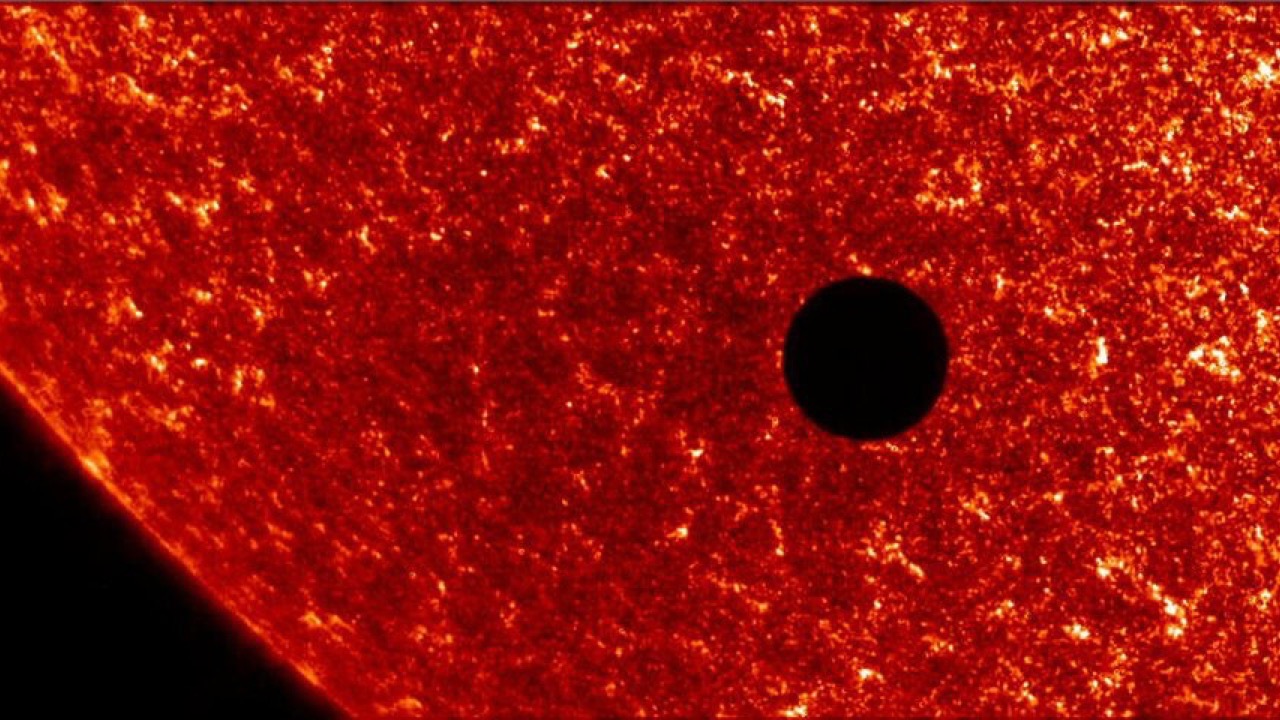 Image by NASA Goddard Space Flight Center / TRACE · Publiek domein, free of copyright · via Wikimedia Commons.

The next transit of Venus begins on December 10, 2117, at 6:58 p.m. EST (23:58 UT), after sunset for most of the country; Hawaii, the Aleutians and the far West see part of it. The one after that is December 8, 2125.
The 2117 transit in US time zones
Venus spends 5 hours 39 minutes on the Sun’s face, from the afternoon of December 10 in Hawaii to just after midnight on the East Coast. The times below are geocentric, meaning as seen from Earth’s center, taken from the canon of transits published by the IMCCE in Paris; NASA’s catalog agrees to the minute. Your own location shifts each moment by up to about 7 minutes.
| Moment | UT | Eastern | Central | Mountain | Pacific | Alaska | Hawaii |
|---|---|---|---|---|---|---|---|
| First contact: Venus touches the Sun’s edge from outside | 23:58 (Dec 10) | 6:58 p.m. | 5:58 p.m. | 4:58 p.m. | 3:58 p.m. | 2:58 p.m. | 1:58 p.m. |
| Second contact: Venus is fully on the disk | 00:21 (Dec 11) | 7:21 p.m. | 6:21 p.m. | 5:21 p.m. | 4:21 p.m. | 3:21 p.m. | 2:21 p.m. |
| Greatest transit: Venus closest to the Sun’s center | 02:48 | 9:48 p.m. | 8:48 p.m. | 7:48 p.m. | 6:48 p.m. | 5:48 p.m. | 4:48 p.m. |
| Third contact: Venus starts to leave | 05:15 | 12:15 a.m. (Dec 11) | 11:15 p.m. | 10:15 p.m. | 9:15 p.m. | 8:15 p.m. | 7:15 p.m. |
| Fourth contact: Venus is off the Sun | 05:38 | 12:38 a.m. (Dec 11) | 11:38 p.m. | 10:38 p.m. | 9:38 p.m. | 8:38 p.m. | 7:38 p.m. |
US times are on December 10 unless marked, at today’s standard-time offsets. Nobody can promise what the time-zone rules will be in 2117.
Can you see the 2117 transit from the United States?
Only from the far West and the Pacific. By the time Venus touches the Sun, the Sun has set almost everywhere from the Rockies to the Atlantic.
We worked this out from the Sun’s height above the horizon at each contact time. Allow a few minutes either way for your exact location.
- Hawaii: Venus enters at 1:58 p.m. HST with the Sun about 40 degrees high. At greatest transit, 4:48 p.m., the Sun is still about 12 degrees up, and it sets around 5:47 p.m., an hour later. Hawaii gets about two-thirds of the transit, though in the last half hour before sunset the Sun is very low.
- Aleutian Islands: at first contact the Sun is about 12 degrees up in Unalaska and 15 degrees in Adak. Adak keeps Venus in view until around mid-transit. Kodiak has the Sun about 6 degrees up at first contact.
- California: at first contact, 3:58 p.m. PST, the Sun stands about 7 degrees above the southwestern horizon and sets within the hour. You’d see Venus enter, and little more, and only with a clear view low to the southwest.
- Arizona: the Sun is about 3 degrees up at first contact and sets around second contact. A clear western horizon is essential.
- Pacific Northwest and mainland Alaska: the Sun is within about 3 degrees of the horizon at first contact in Portland, and a degree or two in Seattle and Anchorage. Possible on paper, unlikely in practice.
- Elsewhere in the Mountain, Central and Eastern time zones: the Sun has set. Nothing to see.
The US territories in the Pacific do better still. Guam and the Northern Mariana Islands see the whole transit, on December 11 from 9:58 a.m. to 3:38 p.m. local time, with the Sun well up the entire time. American Samoa sees nearly all of it, with the Sun reaching the horizon just as Venus leaves.
timeanddate’s listing for 2117 agrees: it names Honolulu, Los Angeles and San Francisco among the places that see part of the transit. Its times run about two minutes later than the IMCCE and NASA figures above, because it uses a different calculation.
Every transit of Venus since the telescope, and the next four
There have been eight transits since the telescope was invented, from 1631 to 2012, and four more are due by 2255. The table puts them side by side, with the date as it fell in the US.
| Transit (UT date) | Contacts I–IV (UT) | Length | Closest to Sun’s center | Date in the US (Eastern) | Seen from the US? |
|---|---|---|---|---|---|
| December 7, 1631 | 03:51–06:47 | about 2h 56m | 939″ | December 6–7, at night | No: night across the country |
| December 4, 1639 | 14:57–21:54 | 6h 57m 39s | 524″ | December 4 | In daylight, but the only known observers were in England |
| June 6, 1761 | 02:02–08:37 | 6h 34m 36s | 570″ | June 5, evening | West of the Rockies the start, before sunset; Hawaii nearly half; Alaska most of it |
| June 3–4, 1769 | 19:15–01:35 | 6h 19m 50s | 609″ | June 3 | Yes: all of it in the West, all but the end in the East |
| December 9, 1874 | 01:49–06:26 | 4h 36m 43s | 830″ | December 8, evening | Only Hawaii and the Aleutians, the first part |
| December 6, 1882 | 13:57–20:15 | 6h 18m 42s | 637″ | December 6 | Yes: all of it east of the Rockies, the West from sunrise |
| June 8, 2004 | 05:13–11:26 | 6h 12m 30s | 627″ | June 8 | East: only the end, at sunrise. West: nothing |
| June 5–6, 2012 | 22:09–04:49 | 6h 39m 57s | 554″ | June 5 | The start, until sunset; all of it in Alaska and Hawaii |
| December 10–11, 2117 | 23:58–05:38 | 5h 39m 33s | 724″ | December 10 | Hawaii about two-thirds, the Aleutians to mid-transit, California and Arizona the start |
| December 8, 2125 | 13:15–18:48 | about 5h 33m | 736″ | December 8 | Yes: all of it in the East, the West from sunrise, Hawaii the end |
| June 11, 2247 | 08:42–14:25 | about 5h 43m | 691″ | June 11 | East: most of it, after sunrise. West: the end |
| June 9, 2255 | 01:08–08:08 | about 7h 00m | 492″ | June 8, evening | Alaska nearly all; the West and Hawaii the start, before sunset. East: nothing |
How to read it:
- Closest to Sun’s center is how far the center of Venus passes from the center of the Sun, in arcseconds (″). The Sun’s radius is about 974″ in December and 945″ in June, so the 1631 transit, at 939″, nearly grazed the edge, while 2255, at 492″, cuts close to the middle. That’s why 2255 is the longest on the list at about seven hours, and 1631 the shortest at under three.
- Length runs from first to fourth contact. Where it’s given to the second it comes from the IMCCE canon or NASA’s detailed predictions; “about” means NASA’s catalog, which rounds to the minute.
- Seen from the US is for today’s 50 states, including Alaska and Hawaii, whatever the borders were at the time. The Pacific territories, such as Guam, often fare differently. For 2004 and 2012 it follows NASA’s visibility descriptions; for the others it’s our own calculation of the Sun’s altitude at each contact.
The people behind these dates, from Jeremiah Horrocks in 1639 to Captain Cook in 1769, are in our history of every transit of Venus.
Why transits only happen in early June or early December
Because Venus’s orbit is tilted 3.4 degrees to Earth’s. Venus overtakes Earth every 584 days or so, but at most of those passes it slips by above or below the Sun. It only crosses the Sun’s face when the pass happens near one of the two points where the orbits intersect, and Earth lines up with those points in early June and early December.
Three degrees sounds small. Venus, though, is much closer to us than to the Sun when it passes, which magnifies the tilt: at a pass it can sit up to about 9 degrees above or below the Sun, more than 15 times the Sun’s apparent width. A transit needs it to be within about 0.28 degrees of the Sun’s center.
The two crossing points are called nodes. Venus crosses the descending node, heading south through Earth’s orbital plane, in early June, and the ascending node in early December. NASA’s catalog notes that in this era transits fall within about a day of June 7 or December 9. The 2117 transit is a December one, at the ascending node, like 1874 and 1882.
The 8, 105.5, 8, 121.5 pattern
Transits come in pairs eight years apart, and the pairs are separated alternately by 105.5 and 121.5 years. Add it up and the whole sequence repeats every 243 years.
You can follow it straight down the table:
| From | To | Gap | Node |
|---|---|---|---|
| December 1631 | December 1639 | 8 years | December |
| December 1639 | June 1761 | 121.5 years | switches to June |
| June 1761 | June 1769 | 8 years | June |
| June 1769 | December 1874 | 105.5 years | switches to December |
| December 1874 | December 1882 | 8 years | December |
| December 1882 | June 2004 | 121.5 years | switches to June |
| June 2004 | June 2012 | 8 years | June |
| June 2012 | December 2117 | 105.5 years | switches to December |
| December 2117 | December 2125 | 8 years | December |
| December 2125 | June 2247 | 121.5 years | switches to June |
| June 2247 | June 2255 | 8 years | June |
The half years mark the switch between nodes: after each long gap, a June pair gives way to a December pair, or the other way around.
Why 243 years? Because that’s when three cycles fall back into step. Using NASA’s figures for Venus’s orbit:
- 243 Earth years = about 88,757 days
- 395 orbits of Venus × 224.701 days = 88,756.9 days
- 152 passes of Venus by Earth × 583.92 days = 88,755.8 days
After 243 years, Earth, Venus and the nodes are lined up almost exactly as before, to within about a day and a half. NASA’s catalog puts it as “88,756 days or 243 years” between members of the same series.
Why there’s never a third transit in a row
Because the eight-year repeat is slightly off. Eight Earth years last 2,922.05 days; five passes of Venus take 2,919.60 days. So every eight years Venus shows up for the meeting about 2.45 days early, and its track across the Sun slides north or south.
The 2004 and 2012 transits show how big that slide is. In 2004 Venus crossed 627″ south of the Sun’s center. Eight years later it crossed 554″ north of it, a shift of about 1,180″. Another step of the same size would have put Venus about 1,735″ north of center in 2020. To touch the Sun in June at all, Venus has to pass within about 975″ of the center: the Sun’s radius of about 945″ plus Venus’s own 29″. So June 2020 came and went without a transit, and the next chance is in December, on the other side of the orbit, in 2117.
The same arithmetic explains the pairs. The first transit of a pair crosses one half of the Sun, the second crosses the other half, and the third would miss.
Who alive today will see one?
Almost nobody. A child born in 2026 would be 91 in December 2117, and even then would need to be in the Pacific or the far West. For most people, June 5, 2012, was the last chance.
The nearest thing is a transit of Mercury, which happens about 13 times a century. Mercury is much smaller, so you need a telescope with a proper solar filter to see it. For US observers the timing of the next two is poor:
| Transit of Mercury | Time (UT) | Eastern time | From the US |
|---|---|---|---|
| November 11, 2019 (the last one) | 12:35–18:04 | 7:35 a.m.–1:04 p.m. | Yes, all of it in the East |
| November 13, 2032 | 06:41–11:07 | 1:41–6:07 a.m. | Over before sunrise in the Lower 48; Puerto Rico and the US Virgin Islands catch the end after sunrise, Guam the first hour before sunset |
| November 7, 2039 | 07:17–10:15 | 2:17–5:15 a.m. | No, before sunrise in all 50 states; Guam and the Northern Marianas catch the first half hour before sunset |
| May 7, 2049 | Times not yet in our database |
Whatever you use to look at the Sun, whether for Mercury, an eclipse or plain sunspots, it needs a certified solar filter in front of the optics. A transit is no exception: Venus dims the Sun by only about 0.1 percent, which changes nothing about how dangerous it is to look.
Frequently asked questions
When is the next transit of Venus?
December 10–11, 2117. In US time it starts on December 10 at 6:58 p.m. EST (3:58 p.m. PST) and ends at 12:38 a.m. EST on December 11. The one after that is December 8, 2125.
Can you see the 2117 transit of Venus from the United States?
Only in the far West and the Pacific. Hawaii sees about two-thirds of it before sunset, the Aleutian Islands see it until around mid-transit, and California and Arizona see Venus enter low in the sky. Elsewhere from the Rockies eastward the Sun has already set. The US territory of Guam sees all of it.
When was the last transit of Venus?
June 5–6, 2012. In the US it began on the afternoon or early evening of June 5, and most of the country saw the start before sunset.
Why are transits of Venus so rare?
Venus's orbit is tilted 3.4 degrees to Earth's, so it usually passes above or below the Sun. It can only cross the disk when it overtakes Earth in early June or early December, and that lines up in pairs eight years apart, separated by gaps of 105.5 or 121.5 years.
Keep reading
More from the sky calendar
- Transits · 9 min readTransit of Venus 2117: Date, Times and Where to See ItDecember 10–11, 2117: all four contact times in UT and US time zones, where on Earth it is visible, and why it repeats the transit of 1874.
- Transits · 8 min readWhat Is a Transit of Venus? Explained With Real NumbersVenus crosses the Sun as a dot 1/32 of its width for about six hours. The four contacts, how it differs from an eclipse, and why it is so rare.
- History · 6 min readJeremiah Horrocks and the 1639 Transit of VenusHorrocks predicted the 1639 transit of Venus and saw it through a gap in the clouds. Only he and William Crabtree watched. The dates, the times, the miss.