Jeremiah Horrocks and the 1639 Transit of Venus
Horrocks predicted the 1639 transit of Venus and saw it through a gap in the clouds. Only he and William Crabtree watched. The dates, the times, the miss.
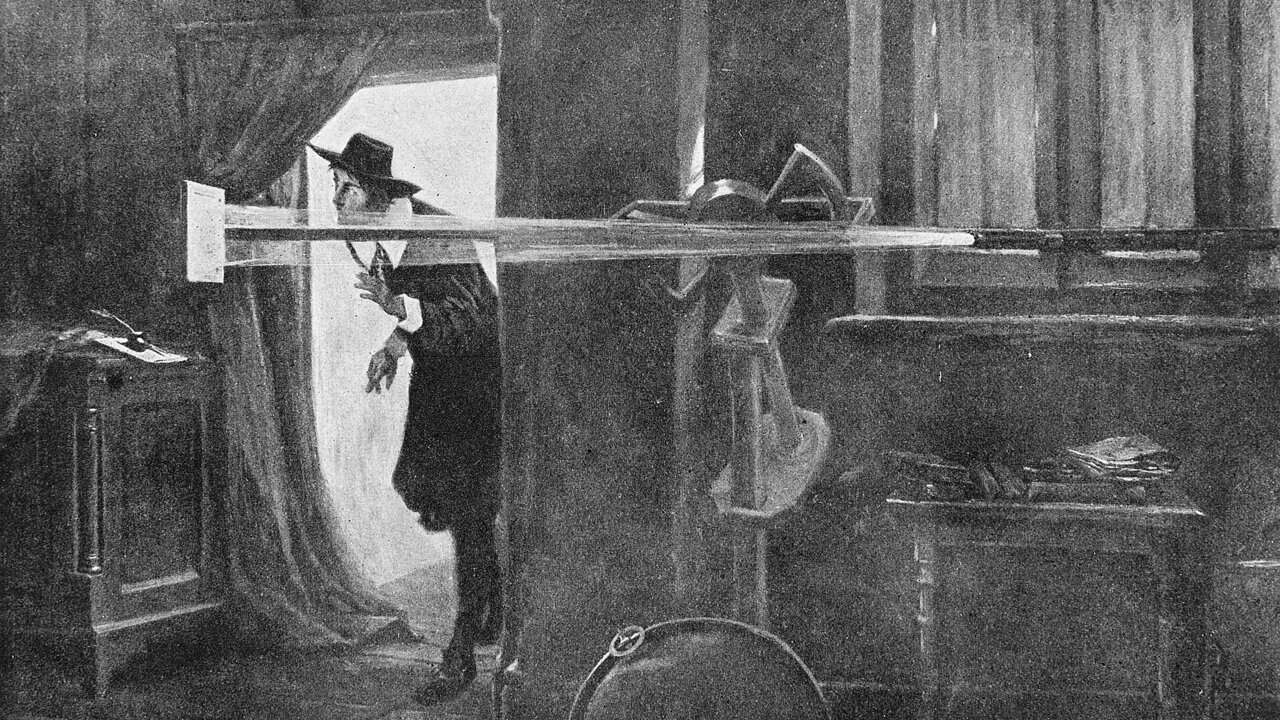 Image by onbekend (Wellcome Collection) · CC BY 4.0 · via Wikimedia Commons.

Jeremiah Horrocks was a young English curate who predicted the transit of Venus of December 4, 1639, and watched it through a break in the clouds in Lancashire. Only he and his friend William Crabtree, about 30 miles away, are known to have seen it.
Who was Jeremiah Horrocks?
Short answer: a young man from Toxteth, Liverpool, who studied at Cambridge, left without a degree and died at about 22. Much of his life is thinly documented.
According to the MacTutor biography, Horrocks was probably born in 1618 in Toxteth and died there on January 3, 1641. The birth year is inferred, not recorded, and sources differ. He entered Emmanuel College, Cambridge, in 1632 and left in 1635 without taking a degree. By 1639 he was working as a curate at Much Hoole, near Preston, and teaching himself astronomy.
Treat the dates in his short life as approximate. The death date is firmer than the birth date. Everything that matters for the transit, from his predictions to the date of the event, is better documented.
How did Horrocks predict the transit?
Short answer: he distrusted the popular tables, corrected Kepler’s own tables, and found a transit Kepler had missed.
Johannes Kepler had predicted a transit of Mercury for November 7, 1631 and a transit of Venus for December 6, 1631. Four observers confirmed the Mercury transit. The Venus transit could not be seen from Europe. Kepler’s tables did not show the next one.
Horrocks found Philip van Lansberge’s tables unreliable. He then improved Kepler’s Rudolphine Tables (1627) and calculated that Venus would cross the Sun on November 24, 1639 in the English calendar. On October 26, 1639 he told Crabtree to watch for it. Horrocks also realized that Venus transits come in pairs eight years apart, which fit 1631 and 1639 together.
Kepler’s 1631 transit was missed entirely. Horrocks, with a better model, got the next one.
Why is the 1639 transit dated both November 24 and December 4?
Short answer: England was still on the Julian calendar, ten days behind the Gregorian calendar that we use. November 24, Old Style, is December 4, New Style.
England kept the Julian calendar until 1752. In 1639 it ran ten days behind the Gregorian calendar used across much of the Continent. Horrocks wrote “24 November”. Anyone converting the date today gets December 4, 1639. That day was a Sunday, which matters for the story below.
The sky does not care about the calendar, and the geometry is the same either way. The IMCCE canon lists the contacts as seen from the center of the Earth:
| Contact | What happens | Time on December 4, 1639 (UT) |
|---|---|---|
| I | Venus’s edge touches the Sun’s edge | 14:56:48 |
| II | Venus is fully on the disk | 15:15:01 |
| Greatest transit | Closest to the Sun’s center | 18:25:36 |
| III | Venus begins to leave | 21:36:15 |
| IV | Venus leaves the Sun | 21:54:28 |
From the Earth’s center, the whole crossing took 6 hours 57 minutes 39 seconds. At closest, Venus passed 8 arcminutes 43.6 arcseconds from the Sun’s center. The Sun’s radius is 16 arcminutes 14.7 arcseconds, and Venus’s is 31.6 arcseconds. By our arithmetic, that makes Venus about 1/31 as wide as the Sun.
Those are geocentric times. An observer in Lancashire would have seen the contacts a few minutes earlier or later, because of parallax, and nobody there timed them with a modern clock. For a sense of how the path crosses the disk, see the transit animation.
What happened on the afternoon itself?
Short answer: the sky was overcast most of the day. The clouds broke at about 3:15 p.m. local time, not long before sunset, and Horrocks saw Venus on the Sun.
On Sunday, November 24 (Old Style), Horrocks had watched from sunrise at Much Hoole until his duties called him to church. A 1939 note in Nature says he resumed observing at 3:15 p.m. In MacTutor’s account, the clouds parted at about that time. He projected the Sun’s image through a simple telescope onto a circle about six inches across, so he never looked at the Sun directly through the lens.
Venus had just entered the disk. Sources differ on how close to sunset he saw it: Wikipedia’s summary says half an hour, while the 2005 paper says about 40 minutes. Whichever is right, he saw only the opening stretch. Greatest transit came at 18:25 UT and the last contact at 21:54 UT, long after the December Sun had set in England.
The timing is close to the table above, but treat it as a rough match. Contact II is 15:15 UT. Horrocks’s 15:15 was local time on his own clock in Lancashire, which is a different thing. Venus was already on the disk when he looked, so he missed contact I, about 18 minutes earlier.
Horrocks measured Venus’s width at 1 arcminute 16 arcseconds. Modern values from the table above give about 63 arcseconds, so he overestimated it by about a fifth. Even so, it was small enough to matter in his next step.
Who was William Crabtree?
Short answer: a cloth merchant in Broughton, near Salford. He was the second observer.
William Crabtree was 29 and worked as a cloth merchant, according to the Linda Hall Library. He watched from Broughton, about 30 miles from Horrocks. He died in 1644, aged about 33. Horrocks and Crabtree are the only known observers of 1639.
Crabtree, like Horrocks, waited under cloud. According to the Nature note, the sky cleared just in time for him. That is why the thing was recorded at all: two men in two places, one lucky gap each.
The transit was also visible across Italy, France, Spain and Portugal, as the 2005 paper notes, yet no other observer is known.
Crabtree has a monument of sorts. In the 1880s Ford Madox Brown painted a mural in Manchester Town Hall showing Crabtree watching the transit.
Why did the account appear only in 1662?
Short answer: Horrocks died on January 3, 1641, thirteen months after the transit. His report, Venus in Sole Visa, was published in 1662 by Johannes Hevelius.
Hevelius printed it together with his own Mercurius in Sole Visus. By then Horrocks had been dead for 21 years. Because of that gap, European astronomers learned of the 1639 transit only 23 years afterward. The later shift to a worldwide effort is told in the overview Every Transit of Venus That Changed Astronomy.
What distance to the Sun did Horrocks calculate?
Short answer: at least 15,000 Earth radii, about 60 million miles. The real figure is about 93 million miles. He was a third too low.
Horrocks used the Venus measurement, and Gassendi’s earlier measurement of Mercury, to argue that the planets look about the same size seen from the Sun: roughly 28 arcseconds. Half of that is the Sun’s parallax, 14 arcseconds. The distance follows from it. Here is the comparison, using our arithmetic with an Earth radius of 3,959 miles:
| Horrocks (1639) | Modern value | |
|---|---|---|
| Sun’s parallax | 14 arcseconds | about 8.8 arcseconds |
| Distance in Earth radii | 15,000 | about 23,500 |
| Distance in miles | about 60 million | about 93 million |
| Horrocks as a share of the true distance | about 64% | 100% |
| Venus’s apparent width during the transit | 76 arcseconds | about 63 arcseconds |
His method was not the one later used. It rested on an assumption about planet sizes, not on timing the transit from different places. By one modern account, Kepler’s own solar system was too small by a factor of seven. Horrocks was off by about a third.
The method that did work needed observers on different parts of the Earth. Halley’s method compared the timing of the contacts from far-apart locations, and it only became practical at the 1761 and 1769 transits.
Frequently asked questions
Who first observed a transit of Venus?
Jeremiah Horrocks, an English curate, on December 4, 1639 (November 24 in the calendar England then used). His friend William Crabtree watched from about 30 miles away. They are the only two known observers.
Why is the 1639 transit dated both November 24 and December 4?
England still used the Julian calendar, which in 1639 ran ten days behind the Gregorian calendar used on the Continent and today. Horrocks wrote November 24 (Old Style). The same day is December 4 in our calendar.
How far did Horrocks think the Sun was?
At least 15,000 Earth radii, about 60 million miles. The true figure is about 93 million miles, roughly 23,500 Earth radii, so he was about a third too low.
Why was Horrocks' account published so late?
Horrocks died on January 3, 1641. His report, Venus in Sole Visa, appeared only in 1662, when Johannes Hevelius printed it alongside his own work on Mercury.
How long did the 1639 transit last?
Seen from Earth's center, 6 hours 57 minutes 39 seconds, from 14:56 to 21:54 UT on December 4. In Lancashire the Sun set long before the end, so Horrocks saw only the early part.
Keep reading
More from the sky calendar
- History · 7 min readThe 1761 Transit of Venus: The First Worldwide CampaignIn 1761 astronomers spread across the globe to time Venus crossing the Sun. Mason and Dixon, Le Gentil, Lomonosov, and why the results varied so widely.
- History · 7 min read1874 and 1882 Transits of Venus: The American ExpeditionsEight US expeditions per transit, $177,000 and $78,000 from Congress, and plates that gave Harkness 8.809". Why it barely counted in the official value.
- History · 8 min readTransit of Venus 2004 and 2012: Times, Visibility, ScienceContact times, visibility and science of the 2004 and 2012 transits of Venus side by side, including why Americans saw 2012 on June 5, not June 6.