Captain Cook and the 1769 Transit of Venus at Tahiti
Why the Endeavour sailed to Tahiti, what Cook, Green and Solander saw at Fort Venus on June 3, 1769, what it cost them, and what the timings were worth.
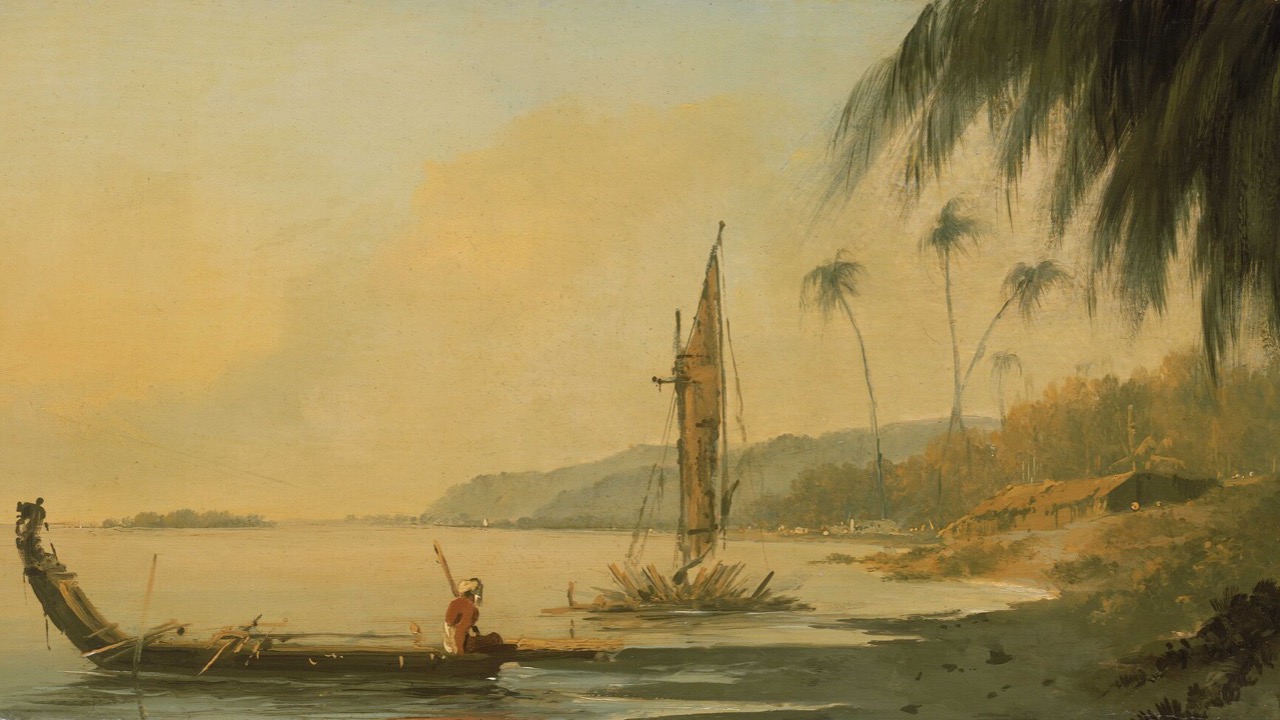 Image by William Hodges · Publiek domein, free of copyright · via Wikimedia Commons.
Captain James Cook sailed the Endeavour to Tahiti to time the transit of Venus of June 3, 1769, for the Royal Society. From Fort Venus he, Charles Green and Daniel Solander watched all of it under a cloudless sky, yet their timings disagreed more than expected.
Why the Royal Society sent a ship to the Pacific
Because the transit of 1761 had left the distance to the Sun unsettled, and 1769 was the last chance for more than a century.
Edmond Halley had shown in 1716 how timing a transit of Venus from places far apart on Earth gives the distance to the Sun. The first attempt, in 1761, produced values for the solar parallax, the angle that sets that distance, anywhere from 8.28 to 10.6 arcseconds: a range of more than 20 million miles. The second transit of the pair, in June 1769, was the last until 1874.
In 1767 the Royal Society’s Transit of Venus Committee chose three sites: the North Cape in Norway, Hudson Bay, and a place in the Pacific. King George III gave 4,000 pounds for the Pacific expedition.
The Pacific made sense for Halley’s method, which needs observers far apart north and south. It also put the whole transit in daylight. At Tahiti, by our calculation, Venus touched the Sun at about 9:17 a.m. local time and left it at about 3:37 p.m., with the Sun never lower than about 23 degrees.
The Endeavour
The Endeavour was a 370-ton former coal ship from Whitby, bought for 2,307 pounds, 5 shillings and 6 pence, more than half the king’s grant for the whole expedition.
Under Lieutenant James Cook she left Plymouth on August 26, 1768, and anchored in Matavai Bay, Tahiti, on April 13, 1769, 230 days after leaving England. That left 51 days to build a camp, set up the instruments and fix the station’s position before June 3.
Three men did the main observing: Cook himself; Charles Green, the expedition’s astronomer; and the naturalist Daniel Solander.
Fort Venus and the outstations
The main station was Fort Venus, on the point at Matavai Bay now called Point Venus. Green determined its latitude as 17°29′15″ south.
That figure holds up. The monument at Point Venus today stands at 17.495 degrees south, which is 17°29′42″. The difference, 27 arcseconds of latitude, is about half a mile on the ground, and the old fort and the modern monument need not stand on exactly the same spot.
Fort Venus was not the only post. Smaller parties watched from Irioa, on the neighboring island of Moorea, and from Taaupiri.
June 3, 1769: the transit in local time
Cook’s journal opens the day plainly: “This day prov’d as favourable to our purpose as we could wish, not a Clowd was to be seen the Whole day.”
Here is how the transit ran. The UT times are from the IMCCE canon of transits; the Tahiti times are local mean time, which we worked out from the longitude of Point Venus; the Eastern times are what today’s clocks on the US East Coast would read.
| Moment | UT | Tahiti, local time | Sun’s height at Tahiti | US Eastern (EDT) |
|---|---|---|---|---|
| I: Venus touches the Sun’s edge | 19:15:26 | 9:17 a.m. | about 34° | 3:15 p.m. |
| II: Venus fully on the disk | 19:34:19 | 9:36 a.m. | 3:34 p.m. | |
| Greatest transit | 22:25:22 | 12:27 p.m. | about 50° | 6:25 p.m. |
| III: Venus starts to leave | 01:16:23 (June 4) | 3:18 p.m. | 9:16 p.m. | |
| IV: Venus is off the Sun | 01:35:16 (June 4) | 3:37 p.m. | about 23° | 9:35 p.m. |
All Tahiti and US times are on June 3. The times are geocentric, as seen from Earth’s center; at any real place each contact shifts by up to about 7 minutes, which is precisely the difference Halley’s method relies on. In the American colonies the Sun set before third contact, so they saw the transit from first contact until sunset.
The whole transit took 6 hours 19 minutes 50 seconds. It was hot work: Cook noted that “the Thermometer expose’d to the Sun about the middle of the Day rose to a degree of heat” the crew had not met with before.
Green and Cook watched with telescopes magnifying 140 times and measured the diameter of Venus as 54.97 and 54.77 arcseconds. The modern figure for that day is 57.7 arcseconds, so both came out about 5 percent small.
The dusky shade: why the times didn’t agree
The weather was perfect; the planet was not. Cook wrote that the three of them saw “an Atmosphere or dusky shade round the body of the Planet which very much disturbed the times of the contacts particularly the two internal ones.”
The internal contacts are II and III, when Venus touches the Sun’s edge from inside. Those were the moments the method depended on, and they were the ones that blurred. Cook was frank about the result: “we differ’d from one another in observeing the times of the Contacts much more than could be expected.” Solander’s telescope magnified more than the matching pair used by Cook and Green, which may have added to the differences.
Two separate effects were likely mixed up in what they saw:
- The black drop. Just before second contact, Venus seems tied to the Sun’s edge by a short dark thread, and the true contact is the moment the thread breaks. It troubled observers at every transit from 1761 to 1882. Modern work on images of the 1999 transit of Mercury shows it needs no atmosphere at all: blurring in the telescope combined with the darker edge of the Sun’s disk is enough. NASA also points to the shimmer of Earth’s own atmosphere.
- A real atmosphere. Venus does have one. In 1761 Mikhail Lomonosov described a bright arc around the planet and took it as a sign of an atmosphere; replications with antique telescopes in 2012 did show the arc.
Either way, the result was the same: three careful observers on the same spot on a clear day could not agree on the instant of contact. Halley had hoped for timings good to 2 seconds.
Sealed orders and the voyage home
The transit was only the first half of the voyage. After it, Cook opened his sealed orders: search for a southern continent.
The voyage home was deadly. Of the 13 men involved in the transit observations, seven died before it was over. Green, the astronomer, died of dysentery on January 29, 1771.
The French expedition of 1769 fared even worse. Jean-Baptiste Chappe d’Auteroche observed in perfect conditions at the southern tip of Baja California, then died in an epidemic that killed almost his entire party; only the engineer Pauly brought the observations back to France. More on both campaigns, and the transit of 1761 that preceded them, is in our history of every transit of Venus.
What the Tahiti timings were worth
More than the disagreements suggested. Thomas Hornsby at Oxford combined the Tahiti timings with those of four other stations and derived a solar parallax of 8.78 arcseconds. The modern value is 8.794148.
| Solar parallax | Distance to the Sun | |
|---|---|---|
| Spread from the 1761 transit | 8.28″ to 10.6″ | about 77 to 99 million miles |
| Hornsby, from 1769 with Tahiti | 8.78″ | about 93.1 million miles |
| Today | 8.794148″ | 92,955,807 miles |
Hornsby’s figure is 0.16 percent too small as a parallax, which makes the distance 0.16 percent too large: about 150,000 miles too far, on a distance of 93 million. We converted the parallax to miles using Earth’s equatorial radius.
Not every reduction of the 1769 data landed that close. The Smithsonian Libraries sum up the combined results of 1761 and 1769 as 94 to 96 million miles, and Johann Encke’s reanalysis in the 1820s gave a little over 95 million. How the method works, and how every later attempt compared, is in how transits of Venus measured the distance to the Sun.
Point Venus today
The site of Fort Venus is marked by a monument obelisk at Point Venus, on Tahiti’s north coast, at 17.495° S, 149.494° W. In 1901 the Royal Society and the Royal Geographical Society added a plaque; a new plaque was placed in 2011.
Point Venus will get another look. By our calculation, at the next transit, on December 10–11, 2117, Venus touches the Sun at about 1:58 p.m. Tahiti time on December 10, with the Sun about 60 degrees high, and the Sun sets around 6:20 p.m., after greatest transit: about three-quarters of the transit, from the same beach.
Frequently asked questions
Why did Captain Cook go to Tahiti?
To time the transit of Venus of June 3, 1769, for the Royal Society. Its Transit of Venus Committee had chosen a station in the Pacific as one of three sites, and King George III gave 4,000 pounds for the voyage.
Where did Cook observe the transit of Venus?
At Fort Venus, a small fortified camp on what is now Point Venus, on the north coast of Tahiti near Matavai Bay. Smaller parties watched from Irioa on Moorea and from Taaupiri.
What went wrong with Cook's observation?
Nothing with the weather: the day was cloudless. But Cook, Charles Green and Daniel Solander saw a dusky shade around Venus that blurred the moments of contact, and their timings disagreed more than they had expected.
How accurate was the distance from Cook's transit data?
Thomas Hornsby combined Tahiti with four other stations and got a solar parallax of 8.78 arcseconds against today's 8.794. That puts the Sun about 93.1 million miles away, 0.16 percent more than the true 92,955,807 miles.
What is at Point Venus today?
A monument obelisk with a plaque placed in 1901 by the Royal Society and the Royal Geographical Society, and a newer plaque from 2011.
Keep reading
More from the sky calendar
- History · 6 min readJeremiah Horrocks and the 1639 Transit of VenusHorrocks predicted the 1639 transit of Venus and saw it through a gap in the clouds. Only he and William Crabtree watched. The dates, the times, the miss.
- History · 7 min readThe 1761 Transit of Venus: The First Worldwide CampaignIn 1761 astronomers spread across the globe to time Venus crossing the Sun. Mason and Dixon, Le Gentil, Lomonosov, and why the results varied so widely.
- History · 7 min read1874 and 1882 Transits of Venus: The American ExpeditionsEight US expeditions per transit, $177,000 and $78,000 from Congress, and plates that gave Harkness 8.809". Why it barely counted in the official value.